
Manual spreading
Manual spreading is performed using a hand crank that acts via a joint lever.

Hydraulic spreading
The spreading is done hydraulically using sliding wedges, supported by a pressure accumulator and a switchable automatic tensioning device. This design allows for reduced spreading force while increasing stability thanks to a large contact surface.

Drive
A three-phase geared motor is used as the drive for unwinding the belt and as an auxiliary drive for feeding in the belt. The drive is controlled via a frequency converter.
A brake attached directly to the drive motor is used to safely stop the drive when the control voltage is switched off.

Manual swivel
The reel is swiveled and locked manually.

Motorized swivel
The reel is swiveled by a geared motor.
An additional rotary encoder enables the swivel to be used as a positioning axis.
This enables smooth acceleration and braking of the reel.
The end position is locked pneumatically.

Pushing Plate
The coil is pushed from the mandrel to the unloading station using the pushing plate.
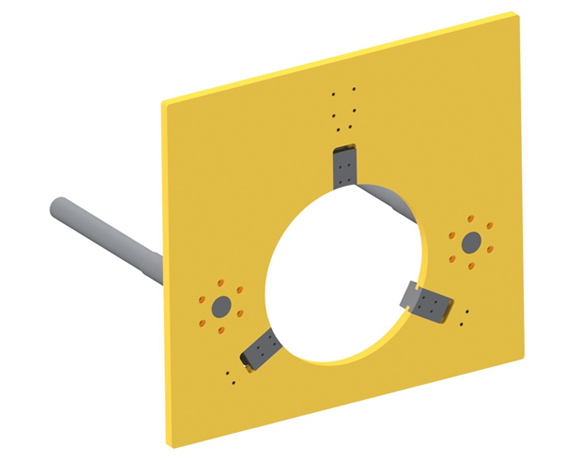
Belt center adjustment via spindle
The belt center is adjusted manually via the spindle by moving the reel.
The protective ring serves as a contact surface. When loading, ensure that the coil is always in contact with the protective ring. The belt width can be read off a scale on the base frame.

Motorized strip centering
The strip center is adjusted by a motor with an absolute encoder via a spindle by moving the reel. The protective ring serves as a contact surface.
During loading, it is important to ensure that the coil always rests against the protective ring.
The strip width can be read digitally on the operator display and stored in the tool data memory.

Clamping Device
The start of the tape is mechanically clamped in a slot.
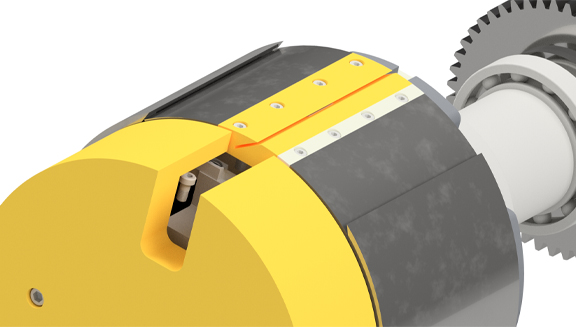
Protective ring
The protective ring is designed as a closed ring made of tubular steel and is connected to the pivot bearing by sturdily dimensioned struts.

Counterholder
A counterholder, which is attached after the coil has been placed on, prevents the coil winding from falling down sideways.
It is designed as a closed ring and equipped with a quick-release clamp.

Separator Arm
Pneumatically actuated, the separator arm prevents the coil from springing open during winding.
The separator arm is mounted in a sturdy bracket that is attached to the reel housing.
The cylinder is equipped with check valves that maintain the pressure in the cylinder in the event of a hose rupture.
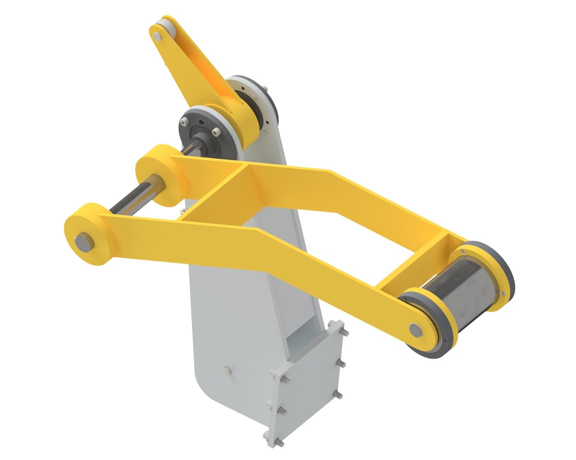
Base frame
The straightener and reel are mounted on a common base frame.
This eliminates the need for additional floor fastening as the tensile force of the straightener is transmitted within the base frame.
The base frame is positioned on the floor using height-adjustable feet. This allows the machine to be precisely aligned without great effort.

Paper Winder
The interleaving paper can be wound using the torque-controlled paper winder.
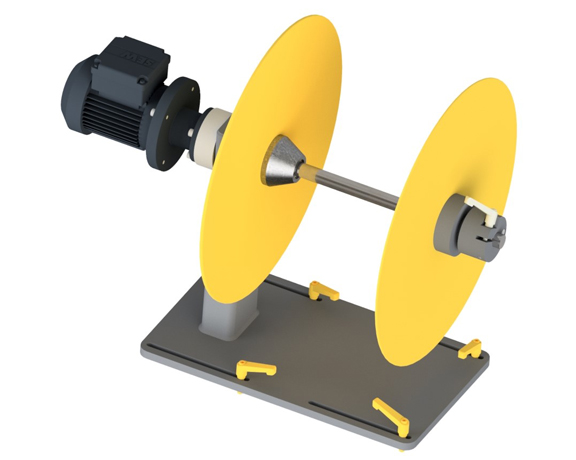
Mobile coil loading chair
The coil loading chair is located outside the coil run, is hydraulically height-adjustable up to the smallest coil outer diameter and is mounted on a traversing device. The coils placed on it can be easily transported to the decoiler.
For safety reasons, large coil weights cannot normally be loaded without a coil loading chair
